Where to Put an Indoor Garden: Choosing a Growing Location
Compare the living room, bedroom, kitchen, bathroom, hallway and home office as growing spaces, and learn what to check at each one and which conditions rule a spot out.
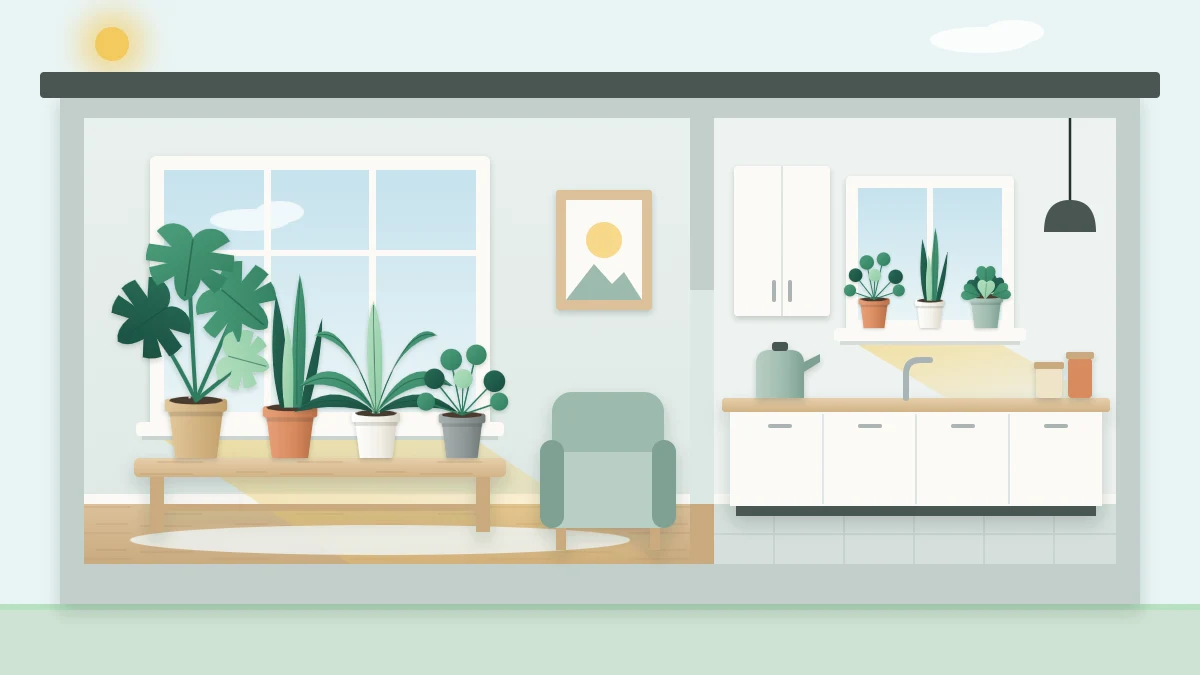
Deciding where to put an indoor garden is mostly a question about light, and then a question about your habits. The room’s name tells you very little. A bedroom with a large clear window can be a better growing space than a living room shaded by the building next door.
This guide compares the usual household locations, explains what to check at each one and lists the conditions that rule a spot out, so you can choose a growing area on evidence instead of on where a gap happens to be.
Light first, and distance from the window
Plants make their food from light, so a location with too little of it cannot be rescued by careful watering or a nicer pot. Check light before anything else.
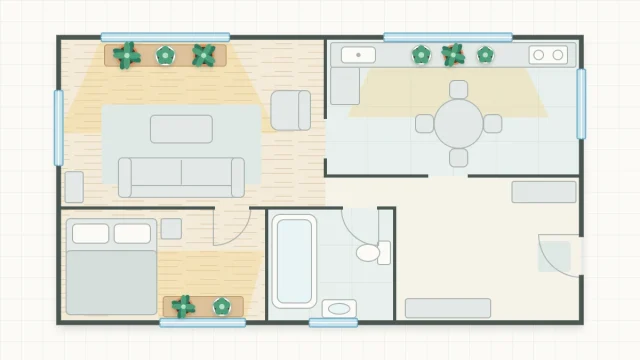
Indoors, light falls away quickly as you step back from the glass. A spot right at a window and a spot across the same room can differ far more than your eyes suggest, because eyes adjust to dimness and leaves do not. This is why distance from the window matters more than the room name: the best place in almost any room is within a few feet of its brightest window, and the middle of the room is often only suitable for plants that tolerate low light.
The direction a window faces changes what it delivers, as the guide to window direction for indoor plants explains. To measure a specific spot without instruments, follow the survey in how to assess natural light in your home.
Household locations compared
The table gives a general picture. Your own rooms may differ, so use it as a list of things to check, not as a verdict.
| Location | What it often offers | What to check |
|---|---|---|
| Living room window | Often the largest windows and the most floor space; you see the plants daily | Radiators or vents under the window; furniture blocking access |
| Bedroom | Quiet, steady conditions and little foot traffic | Curtains or blinds kept closed for much of the day; cooler nights |
| Kitchen | Water close at hand; you pass by many times a day | Heat and steam near the stove; limited counter and windowsill space |
| Bathroom | Higher humidity after showers | Small or frosted windows; some bathrooms have no usable light at all |
| Hallway | Unused floor or wall space | Usually dim; drafts from outside doors; pots in the path of traffic |
| Home office | You are present for long stretches and notice changes | Blinds lowered against screen glare; equipment that must stay dry |
| Spare corner with a grow light | Frees you from depending on a window | A nearby outlet, a fixture suited to the space, and a plan for trays |
If you choose a lamp-lit corner, use the grow light as supplied and follow the fixture manufacturer’s instructions for mounting, distance and running time, and keep the fixture and its connections away from water.
Temperature swings and moving air
After light, look at what the air does. Most common indoor plants are comfortable at ordinary room temperatures, but many dislike sudden change. The usual trouble spots are easy to find once you look for them:
- a windowsill directly above a radiator or baseboard heater
- the stream of air from a heating or cooling vent, or from an air conditioner
- beside an outside door that lets in cold air each time it opens
- against single-pane glass that turns very cold on winter nights or very hot in summer sun
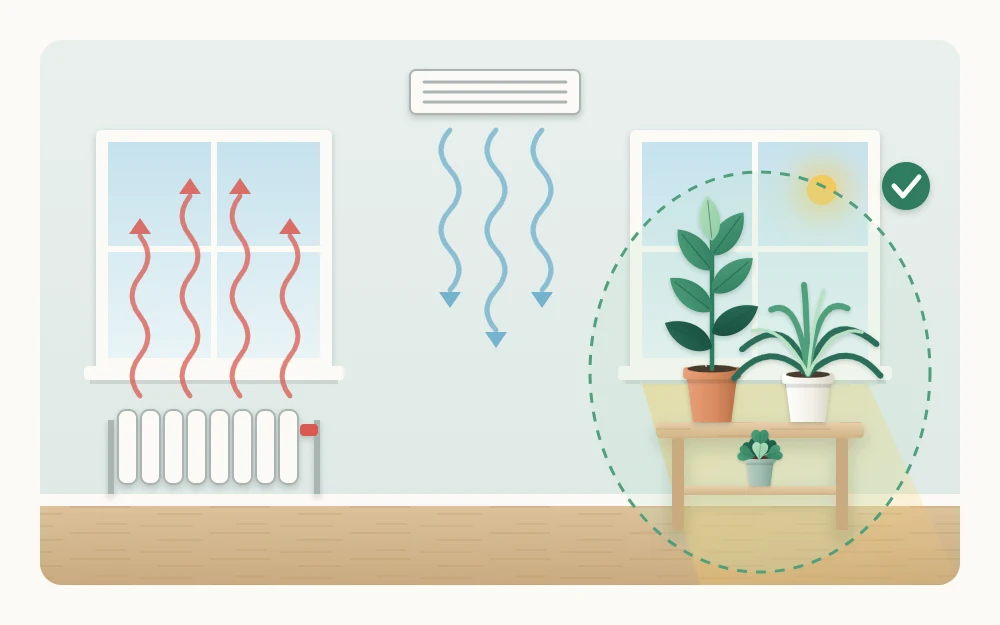
Hold your hand where the pots would stand while the heating or cooling is running. If you feel a steady stream of warm or cold air, the plants will too. For more on how warmth and moisture in the air affect plants, see the University of Maryland Extension’s page on temperature and humidity for indoor plants.
Humidity from room to room
Kitchens and bathrooms are often a little more humid than living rooms and bedrooms, especially in homes with central heating. That can help thin-leaved plants, but it does not make up for poor light. A bright living room usually beats a dim bathroom.
Many common indoor plants cope well with ordinary room air, so treat humidity as a tiebreaker between two spots that are both bright enough. The guide to humidity in an indoor garden covers what makes a real difference and what does not.
Why a visible, convenient spot gets better care
An indoor garden depends on being looked at. Plants in a place you pass every day get noticed when the potting mix dries, when a stem leans or when a leaf changes color. Plants in a spare room behind a closed door are easily forgotten until something has clearly gone wrong.
Convenience matters just as much. Ask how far each spot is from a tap, whether you can reach the back row without moving furniture, and whether there is a surface nearby to set a pot down. Between two spots with similar light, choose the one that is easier to reach with a watering can.
What rules a spot out
Some locations are not worth trying to fix. Cross a spot off your list if:
- it has no usable natural light and you have no plan for a grow light
- it sits directly above a radiator or in the stream of an air conditioner, and the pots cannot be moved clear
- pots will be knocked there: a narrow passage, the swing of a door, a ledge a pet uses, or beside a play area
- a spill would land on something that cannot get wet and there is no room for a tray
- you cannot reach the pots to check and water them without a struggle
Tip
Before committing to a location, leave an empty tray there for a few days. You will soon learn whether it gets bumped, whether it is in your way and how often you actually pass it.
Floors, furniture and going upward
Any location needs something waterproof under the pots. Check that the surface is level, that it can take a saucer or tray, and that a little spilled water will not ruin what lies beneath. Wood floors, carpets and veneered furniture all deserve a tray.
When the best light falls on a narrow strip beside a window, a tall unit can fit several pots into that strip where a table would hold only two or three. The guide to setting up indoor garden shelves explains how to arrange one. Wet pots are heavy, so check the unit’s stated load rating before filling it.
Frequently asked questions
What is the best room for an indoor garden?
There is no single best room. The strongest candidate is whichever room has the brightest clear window with space close to it, away from radiators and vents, in a place you pass daily. In one home that is the living room; in another it is a bedroom or kitchen. Check the light before deciding.
Can I keep an indoor garden in a room with no window?
Only with a grow light doing the work that daylight would. Without usable natural light or a lamp, a windowless room is not a growing space. If you add a fixture, use it as supplied and follow the manufacturer's instructions for mounting, distance and running time.
How close to the window should plants be?
It depends on the window and the plant, but light falls away quickly with distance, so most growing areas work best close to the glass. Plants that prefer bright indirect light may sit slightly back or to one side of a sunny window. Leaves should not press against the pane.