Humidity in an Indoor Garden: What It Is and What Actually Helps
What relative humidity means, why heated and air-conditioned rooms are often dry, which plants notice, and which measures make a real difference, from choosing the room and grouping plants to humidifiers and enclosed cases.
Advice about humidity for indoor plants tends to swing between two extremes: either it is the hidden cause of every brown leaf tip, or it does not matter at all. Neither is quite right. Dry air matters a good deal to some plants and very little to others, and several popular remedies do much less than their reputation suggests.
It helps to understand what humidity is, find out what your own rooms are like, and then choose the measures that make a real difference for the plants that need it.
What relative humidity means
Air always holds some water vapor. Relative humidity describes how much it holds compared with the most it could hold at that temperature, given as a percentage. Warm air can hold more vapor than cold air, which is the key to everything that follows: when cold outdoor air is brought inside and heated, the amount of vapor stays the same but the air’s capacity rises, so the relative humidity falls.
Plants lose water through their leaves all the time. The drier the surrounding air, the faster that happens, and a plant whose leaves lose water faster than its roots can replace it shows the strain at the leaf edges and tips first.
Why indoor air is often dry
Heated rooms in winter are the classic dry environment, for the reason above, and the effect is stronger the colder it is outside. Air conditioning also removes moisture as it cools. Positions directly in the path of a heating vent, a radiator or a cooling unit are drier still, because moving air strips moisture from leaves quickly.
How dry your home gets depends on the climate, the season, the heating or cooling system and how the rooms are used.
Which plants notice it
Many common indoor plants cope with ordinary room air without any special measures. Plants with thick, waxy or leathery leaves generally tolerate dry air well. Thin-leaved tropical plants, such as many ferns and calatheas, tend to notice it most, and they are the ones worth planning around.
So the question is less “is my home humid enough?” and more “do the plants I grow, or want to grow, need more than my rooms provide?” For general background, see University of Maryland Extension’s page on temperature and humidity for indoor plants.
Measure before you change anything
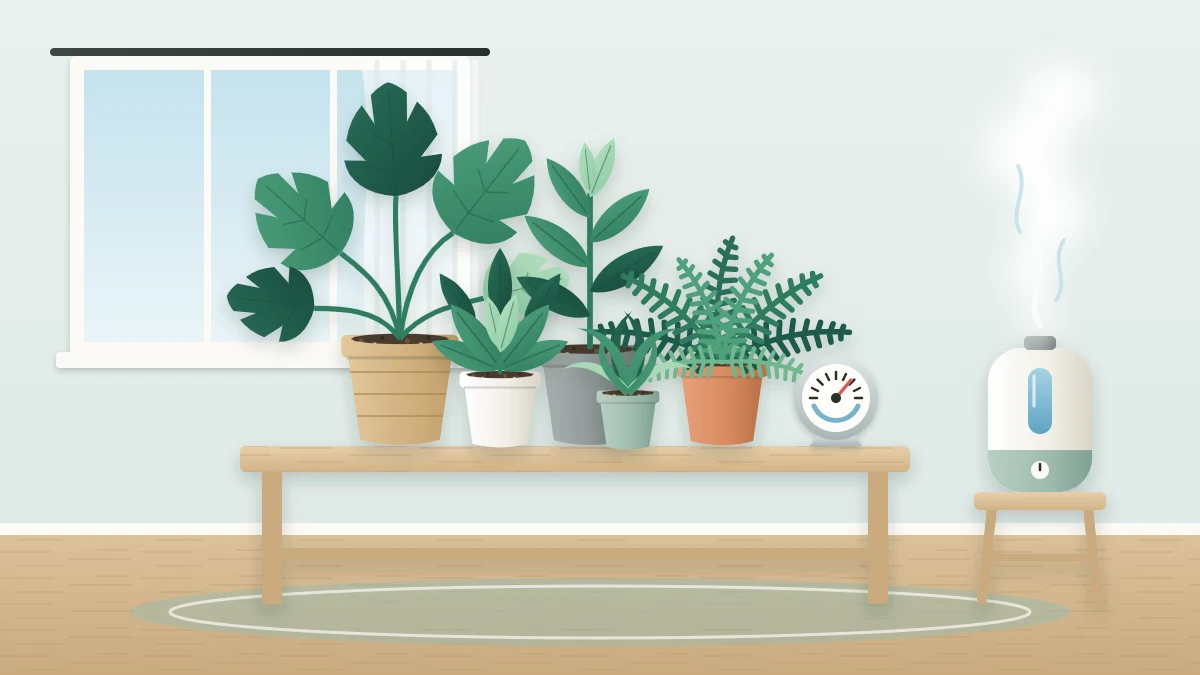
A simple hygrometer, an inexpensive instrument that displays relative humidity, shows what a spot is really like. Set it at plant height in the growing area, away from direct sun, and read it at different times of day over a week or two. Then repeat the exercise in another season, because the winter and summer figures are often far apart.
There is no single target that suits every indoor garden, and this guide does not give one. The reading is most useful as a comparison: between rooms, between seasons, and before and after you try something.
What helps, in order of effect
1. Choose a more humid room that also has enough light
Kitchens and bathrooms are often more humid than living rooms and bedrooms, simply because of how they are used. If one of them also offers the light your humidity-loving plants need, moving the plants there costs nothing. Light still comes first; a steamy room with a tiny window is not a growing area. The guide on where to put an indoor garden covers how to weigh rooms against each other.
2. Group plants together
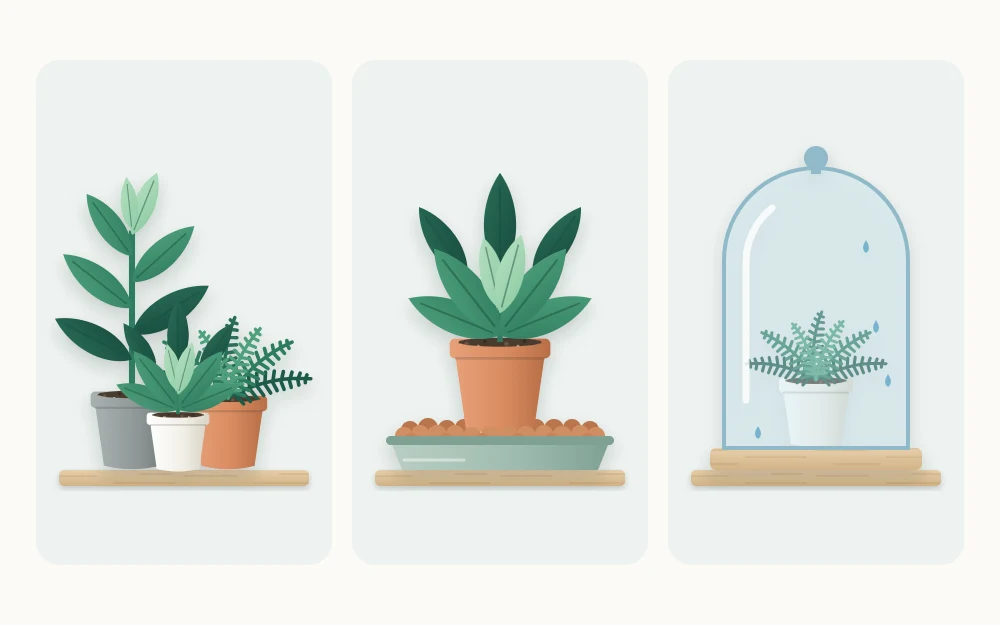
Plants release moisture from their leaves and from the surface of the potting mix. Standing several close together lets that moisture linger among the foliage, so the air inside the group is a little more humid than the room. The effect is modest but constant, and grouping indoor plants has other advantages for care and appearance.
3. Run a room humidifier
A humidifier is the only common measure that raises the humidity of a whole room, and the hygrometer will show the change. Size it to the room, place it near the plants without letting the output settle on leaves, walls or furniture, and run and clean it exactly as its instructions say.
4. Enclose the plants that need high humidity
A few plants want air more humid than is practical, or desirable, for a lived-in room. For those, an enclosed glass case or a terrarium holds moist air around the plants alone. See the guide to dish gardens and terrariums for how these contained plantings work.
What helps only a little
Two widely repeated measures have limited effect, and it is better to know that than to rely on them.
- Misting. A fine spray raises the humidity around the leaves only briefly; once the droplets evaporate, the air returns to what it was. It is not a substitute for the measures above.
- Pebble trays. A tray of pebbles and water under a pot adds a small amount of moisture to the air immediately around it. The effect is local and slight, and largest in still air. If you use one, keep the base of the pot above the water line so the potting mix does not stay saturated.
Humidity and the room itself
Moisture you add for plants ends up in the room as well. Watch for condensation on windows, on cold exterior walls and behind furniture, particularly in winter. Persistent dampness on those surfaces can lead to mold and damaged finishes, and it is a sign to ease off.
Allow air to move. Leave a little space between plants and the wall, and ventilate the room as you normally would.
Good to know
If raising the humidity for a few plants means condensation on the windows, the room is telling you it has had enough. An enclosed case for those plants is usually the better answer than a wetter room.
Do not treat humidity as a diagnosis
Brown leaf tips, crisp edges and curling leaves are the signs usually blamed on dry air. The same signs can come from potting mix that has been too dry or too wet, from roots that have filled the pot, or from a position in hot sun or a draft. They overlap too much for the leaves alone to tell you the cause.
Check the simpler things first: how the potting mix feels, how long since the plant was repotted, and what stands near it. Then look at the hygrometer. If the air is clearly dry and the plant is a thin-leaved type, humidity is a reasonable place to act.
Frequently asked questions
Does misting increase humidity for plants?
Only for a short time. A fine spray dampens the leaf surface and the air right around it, but once the droplets evaporate the air returns to its earlier state. Misting is not harmful to most plants, yet it does not replace grouping, a room humidifier or an enclosed case for plants that need moist air.
Do pebble trays really work?
A little. Water evaporating from the tray adds a small amount of moisture to the air directly around the pot, and the effect fades within a short distance, especially where air is moving. Treat a pebble tray as a minor local aid, and keep the pot's base above the water line.
What humidity level do indoor plants need?
It varies by plant, so no single figure suits every indoor garden. Many common indoor plants manage in ordinary room air, while thin-leaved tropical plants prefer it more humid. Use a hygrometer to learn what your rooms are like through the year, then look up the plants you grow and compare.