Indoor Plant Display Ideas: Designing an Attractive Arrangement
Practical design principles for a plant group that looks composed instead of cluttered: vary height, group in odd numbers, contrast leaves, repeat one pot element and leave space, with ideas for a console table, corner, sideboard and bookshelf.
A collection of plants can look cluttered even when every plant in it is growing well. The usual cause is not the plants or the pots but the arrangement: everything at one height, in one row, with nothing tying it together. The indoor plant display ideas below are a handful of design principles applied to pots, and none of them requires buying more plants.
One rule sits above all the others and is explained first, because it decides which arrangements are possible at all.
Design follows growing conditions
Every plant in a display still has to get the light it needs. An arrangement that looks perfect but puts a sun-loving plant in a dim corner will look worse within a couple of months, as the plant stretches and thins.
So compose within one light zone. Decide where the display will go, work out what light that spot offers, and build the group from plants that suit it. If you are choosing plants for the purpose, the guide to indoor foliage plants sorts common ones by leaf form and the light they tend to tolerate. Design then happens inside those limits, and there is still plenty of room to work.
Vary the height
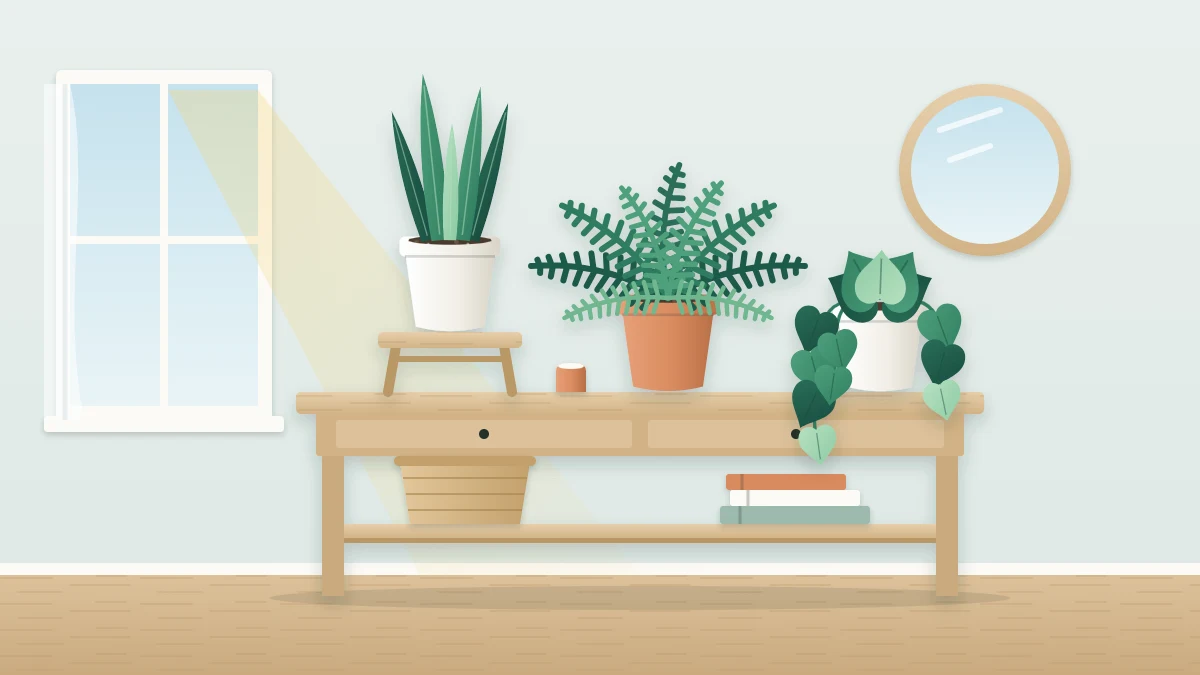
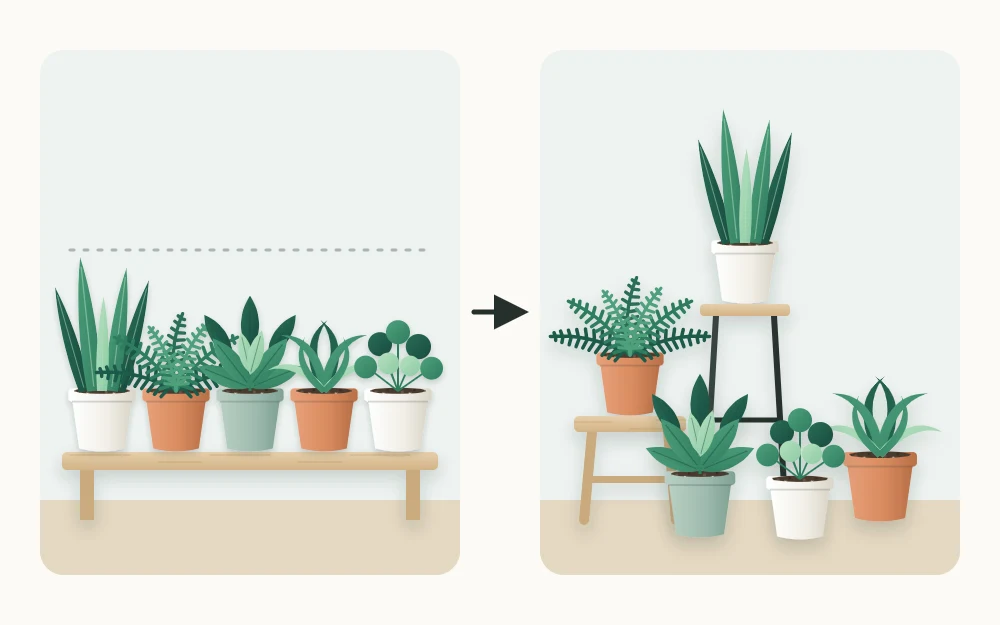
The quickest improvement to a flat row is to give it three levels: something tall, something medium and something low. The eye then moves across the group instead of sliding along a single line.
You do not need plants of three sizes to do this. Raise ordinary pots with whatever is stable and suits the room:
- A plant stand or a small stool
- A short stack of large books, with a saucer to keep them dry
- An empty pot turned upside down as a plinth
- A low bench or a sturdy wooden crate
Check that each raised pot sits flat and cannot be knocked off. Use trailing plants at the highest points, where the stems have room to fall, and keep the lowest, bushiest plants at the front.
Group in odd numbers
Groups of three or five tend to look more natural than pairs or fours, because an even number invites the eye to split the group down the middle. Three plants at three heights, set as a loose triangle instead of a line, is the most reliable small composition there is.
This is a guideline, not a law. Two matching plants either side of a doorway look deliberate because the symmetry is the point. For informal groups on a table or the floor, odd numbers are the easier route.
Contrast the leaves, repeat one element
A group reads as designed when it has both variety and unity. Variety comes from the plants: set a broad, glossy leaf beside a fine, feathery one, an upright plant beside a trailing one, a dark green beside a patterned or pale leaf. Three plants with similar foliage blur into one mass; three with different leaf shapes each stay distinct.
Unity comes from repeating one thing across the group. The simplest choice is the container: one pot color, or one material such as terracotta, glazed white or woven baskets. Mismatched pots are the most common reason a collection looks cluttered. You do not have to repot anything to fix it. A cachepot, which is a decorative outer pot without a drainage hole, lets you slip the plain nursery pot inside and change the look in seconds. The guide to choosing indoor plant containers covers sizes and materials.
Give the group a front and some space
Decide where the display will mostly be seen from and arrange it for that viewpoint: tallest at the back or to one side, lowest at the front, each plant’s best face turned outward. A group that tries to look good from every direction usually looks arranged from none.
Then leave empty space around it. A clear stretch of tabletop or wall beside the group is what makes it read as a composition instead of storage. If a surface is covered edge to edge, take one or two pots away and see whether the rest looks better. It usually does.
Gather small pots, or use one large plant
Many small pots dotted around a room are the hardest thing to make look good. Two fixes work well.
First, gather them. A tray, a shallow basket or a low bench turns six scattered pots into one object with a clear edge. The tray also protects the surface and makes the whole group easy to lift for cleaning.
Second, consider one large plant as an anchor instead of several small ones. A single substantial plant in a good pot gives a corner or the end of a sofa a focal point that a cluster of small pots cannot. Smaller plants can then be grouped at its base, at a lower height, as supporting detail.
Ideas for four common spots
A console table
Use the triangle: a tall plant on a small stand at one end, a medium bushy plant beside it and a low trailing plant at the front, with the other end of the table left clear or given a lamp or a single object.
A floor corner
Start with one large plant as the anchor, then add one or two smaller ones on a stool and on the floor in front. Corners are often dimmer than they appear, so confirm the light before committing.
A sideboard
A long surface suits an off-center group of three or five on a tray, balanced by empty space or one low plant at the opposite end. Keep heights below any picture or mirror hanging above.
A bookshelf
Give plants their own gaps instead of squeezing them between books, and let one trailing plant hang from an upper level. Shelves away from a window can be quite dim; the guide to setting up indoor garden shelves covers light, trays and load ratings for shelf growing areas.
Refresh the display when you rotate
Plants grow, so a display is never finished. The natural moment to adjust it is when you turn the pots to keep growth even. While each pot is in your hands, swap a couple of positions, bring a plant that is looking its best to the front and move one that has grown tall toward the back.
Good to know
Keep swaps within the same light zone. Moving a plant to a noticeably brighter or dimmer position for the sake of the composition changes its growing conditions, and how well it copes varies by plant and home.
Frequently asked questions
How do I make my plants look less cluttered?
Gather scattered pots into one or two groups, raise some of them so the group has three heights, and repeat one element such as a pot color or material. Then leave clear space around each group. Removing a pot or two often improves the look more than adding anything.
Do all the pots in a display have to match?
No, but one repeated element helps a group look intentional. That could be a single color, one material such as terracotta, or one shape. Decorative outer pots let you achieve this without repotting: the plant stays in its plain nursery pot and simply sits inside.
Can I put plants anywhere they look good?
Only where the light also suits them. A plant placed for looks in a spot that is too dim or too sunny for it will decline, and the display with it. Choose the location first, find out what light it gets, and build the group from plants suited to it.