Grouping Indoor Plants by Light and Water Needs
Sort a scattered collection into two or three practical groups that share light and drying pace, place each group in the right part of the room and space the pots so they are easy to check.
When pots are scattered wherever there was a free surface, every plant becomes its own small project. One dries out in two days, the one beside it stays damp for much longer, and half of them sit in light that does not suit them.
Grouping indoor plants by what they need turns that scatter into a garden. Plants that want similar light and dry at a similar pace share a growing area and a checking routine, which makes the whole collection quicker to look after and easier to read.
Why grouping by needs works
Light and water are linked. A plant in a bright spot generally uses water faster than the same plant in a dim one, and a plant adapted to dry conditions wants its potting mix to dry further than a thin-leaved plant from a moist habitat.
If plants with opposite needs stand together, you end up compromising: the spot is too bright for one or too dim for the other, and you have to remember which pots to skip as you go round. When neighbors want the same things, one look tells you how the whole group is doing, and an odd one out is easy to spot.
Find out what each plant needs
Before sorting, gather two kinds of information for every plant.
- What it is said to need. Read the plant label, note the botanical name and look it up in a reliable source such as a university extension service or a horticultural society. Labels are brief and sometimes generic, so a second source helps.
- What it does in your home. Over a few weeks, notice how fast each pot dries. Push a finger into the mix or lift the pot to feel its weight. Pot size, pot material and potting mix all change the pace, so two plants of the same kind may behave differently.
The second point matters as much as the first. A plant in a small terracotta pot can dry far faster than its label suggests, and it may belong with a different group until it is repotted.
Sort the collection into two or three groups
You do not need a group for every plant type. For most homes two or three practical groups are enough, and the ones below are a common starting point.
| Group | Light it suits | How the mix is kept | Typical members |
|---|---|---|---|
| Bright and drier | The brightest spots, often with some direct sun | Allowed to dry well between waterings | Often thick-leaved or fleshy plants, such as many cacti and succulents |
| Bright indirect and evenly moist | Bright indirect light, out of strong direct sun | Watered when the upper part of the mix feels dry | Many thin-leaved tropical foliage plants and many ferns |
| Lower-light tolerant | Farther from the window | Dries slowly, so checked before any watering | Plants sold as tolerant of low light, such as snake plant or ZZ plant |
These are hedged examples, not a classification. Check each plant by name, and move any that prove you wrong. If a plant does not fit any group, let it stand alone until you find where it does well.
Place each group in the right zone
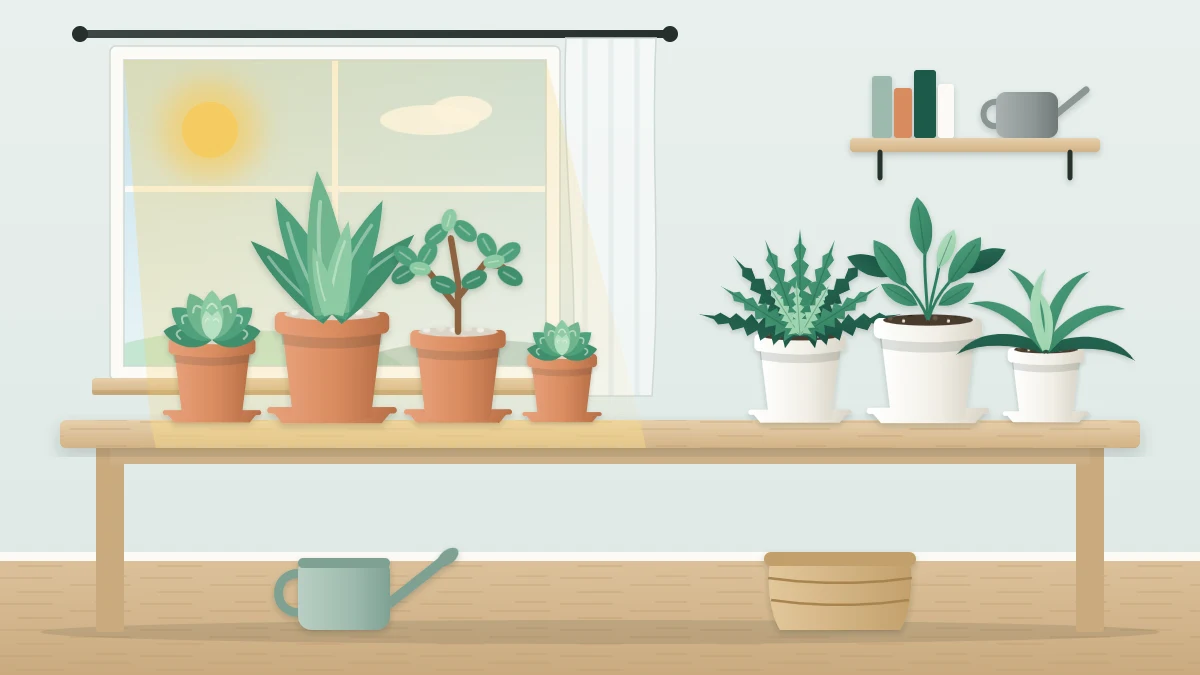
Light falls off quickly as you move away from a window, so think of the room as bands of brightness. Give the brightest band, on or right beside the sunniest window, to the group that wants the most light. Set the bright-indirect group next: beside the window but out of the beam, or a short step back. The lower-light group goes deeper into the room, still within sight of a window.
How bright each band is depends on the window’s size and direction, the season, and anything outside that blocks the sky, so test the arrangement and watch the plants. Stretched, leaning growth suggests a group wants to move closer; pale or scorched patches suggest it wants to move back.
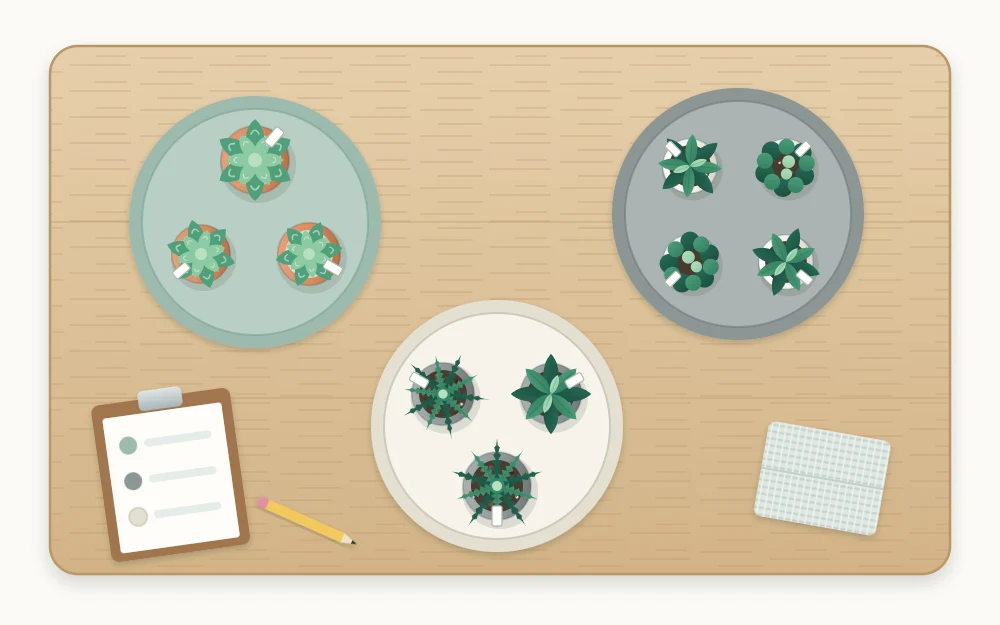
Giving each group its own tray makes the boundaries obvious and protects the surface. For ideas on staging the groups at different heights, see these ways to display indoor plants.
Leave space between pots
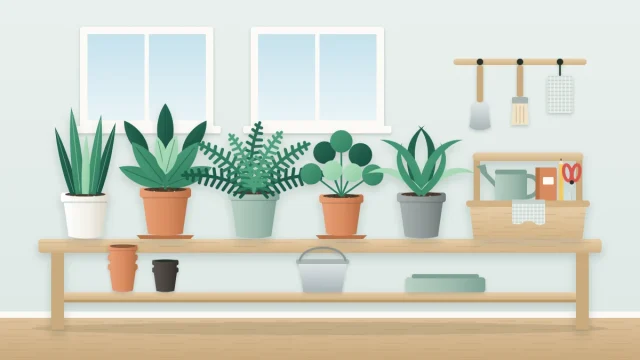
A group should look full without being jammed together. Aim for leaves that almost touch but do not press into each other, with enough room to slide a hand between pots.
- Air can move around the leaves, so they dry after misting or splashes.
- Every plant gets its share of light instead of sitting in a neighbor’s shade.
- You can reach each pot to feel the mix, look under the leaves and lift it out.
- Wiping the tray and clearing fallen leaves takes seconds, not a full dismantling.
Crowding is usually the result of adding plants one by one. When a group gets tight, split it or move its largest member to the floor nearby.
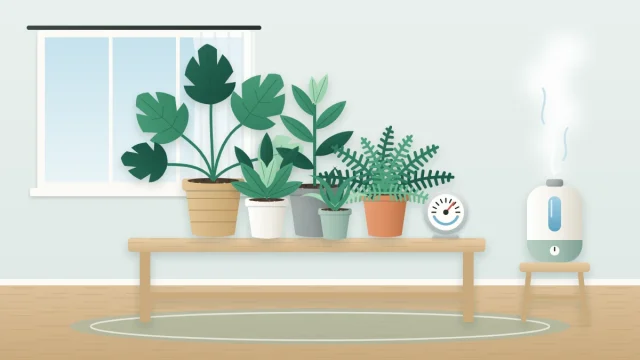
Grouping also raises humidity slightly among the leaves, which some plants appreciate; the guide to humidity for indoor gardens explains how much difference that makes.
Check a group, not a calendar
The payoff of grouping is a simpler routine. Walk round on a regular day and check each group in turn, starting with the one that dries fastest. Within a group the pots tend to be ready at similar times, though never exactly together, so still test each one before you pour.
Good to know
A group shares a checking routine, not a watering date. How quickly a pot dries varies with the plant, the pot, the mix, the season and your home, so let the mix decide.
The full method is in the guide to watering an indoor garden.
Add new plants slowly
Keep a newly bought plant apart from the group for a couple of weeks. Stand it in similar light in another spot, look it over, including under the leaves, and see how fast it dries in your conditions.
That gap protects the rest of the garden and gives you the information you need to choose its group. When it joins, put it at the edge at first, where it is easy to watch and easy to take out again.
Tip
Review your groups when the seasons change. As the sun’s angle and the indoor heating shift, a group that suited a sill in winter may need to move back in summer.
Frequently asked questions
Which indoor plants can be grouped together?
Plants that want similar light and whose potting mix dries at a similar pace. In practice that often means one group for sun-loving plants that like to dry out, one for plants that prefer bright indirect light and steadier moisture, and one for those that tolerate lower light. Check each plant by name first.
How close together should grouped plants be?
Close enough to read as one group, but with leaves that do not press into each other. You should be able to slide a hand between pots, lift one out and see the tray underneath. If you cannot reach a pot to feel its mix, the group is too tight.
Does grouping plants mean they can all be watered at the same time?
Not quite. Pots in a well-matched group tend to be ready at similar times, which makes checking faster, but pot size, material and potting mix still cause differences. Test each pot before you pour and skip any that are still damp.