Indoor Gardening Supplies: What You Need and How to Organize It
A short kit list for an indoor garden, split into essentials and nice-to-haves, plus a two-container system for storing everything in a home without a shed.
Outdoor gardeners have sheds. Indoor gardeners have a kitchen drawer, the cupboard under the sink and a bag of potting mix that keeps falling over in the hall closet. The tools themselves are few; the real question in most homes is where they live.
This guide gives a short, honest list of indoor gardening supplies, split into what you will use constantly and what is merely pleasant to have, and then a simple way to organize it all in a home without a utility room. Everything is described by type, because the type matters far more than the label on it.
The essentials
These are the items that earn their space. With them you can water, tidy, pot and clean up after yourself.
- A watering can with a long narrow spout. The spout is the point. It reaches under leaves to the surface of the mix and lets you pour slowly, which matters on a crowded shelf.
- Saucers or trays. Every pot with drainage holes needs something under it to catch runoff. Keep a couple of spares in different sizes.
- Snips or small scissors. For removing dead leaves and spent flowers cleanly. Keep a pair just for plants so they stay sharp and clean.
- A soft cloth. For dusting leaves and wiping sills and trays.
- A hand trowel or scoop. A narrow one fits into indoor-sized pots. A sturdy kitchen-style scoop does the same job.
- A potting tray or sheet. Something with raised sides, or an old sheet, to contain the mess when you pot on a table or floor.
- Spare nursery pots. The plain plastic pots plants are sold in are worth keeping. They have good drainage, stack flat and slip inside decorative outer pots.
- A bag of suitable potting mix. A general-purpose indoor potting mix covers most common indoor plants. The guide to potting media for indoor gardens explains when a different medium makes sense.
The nice-to-haves
None of these is needed on day one. Add them when a real need shows up.
| Item | What it helps with | Worth knowing |
|---|---|---|
| Hygrometer | Shows the humidity near your plants | Useful for comparing rooms and seasons |
| Moisture meter | A rough second opinion on deep pots | A rough aid only; confirm with a finger or the pot’s weight |
| Plant labels and a pencil | Names and dates on each pot | Pencil lasts on labels better than most ink |
| Turntable or plant caddy | Turning and moving heavy pots | Check the stated load rating; wet pots are heavy |
| Plug-in timer for lights | Switching a grow light on and off consistently | Follow the fixture manufacturer’s guidance on running time |
Good to know
Use grow lights and timers as supplied, follow the manufacturer’s instructions, and keep fixtures and connections away from water. For any question about household wiring, ask a qualified electrician.
What you do not need to start
It is easy to buy a full kit before owning a single plant. Hold off on these until you know you want them:
- Large tool sets. Indoor work rarely needs more than a scoop and snips.
- A mister. Whether misting helps depends on the plant and the room, and it is no substitute for checking the potting mix.
- Leaf-shine products. A soft damp cloth is enough.
- Several specialty mixes. Buy a special medium when you have a plant that calls for it, not in advance.
- Decorative pots in bulk. Choose them once you know the pot sizes you actually have.
- Grow lights. Assess the natural light in your growing area first. Many indoor gardens begin on window light alone.
Organizing supplies in a home without a shed
The trick is to split the kit in two by how often you use it and how messy it is.
The everyday kit, near the plants
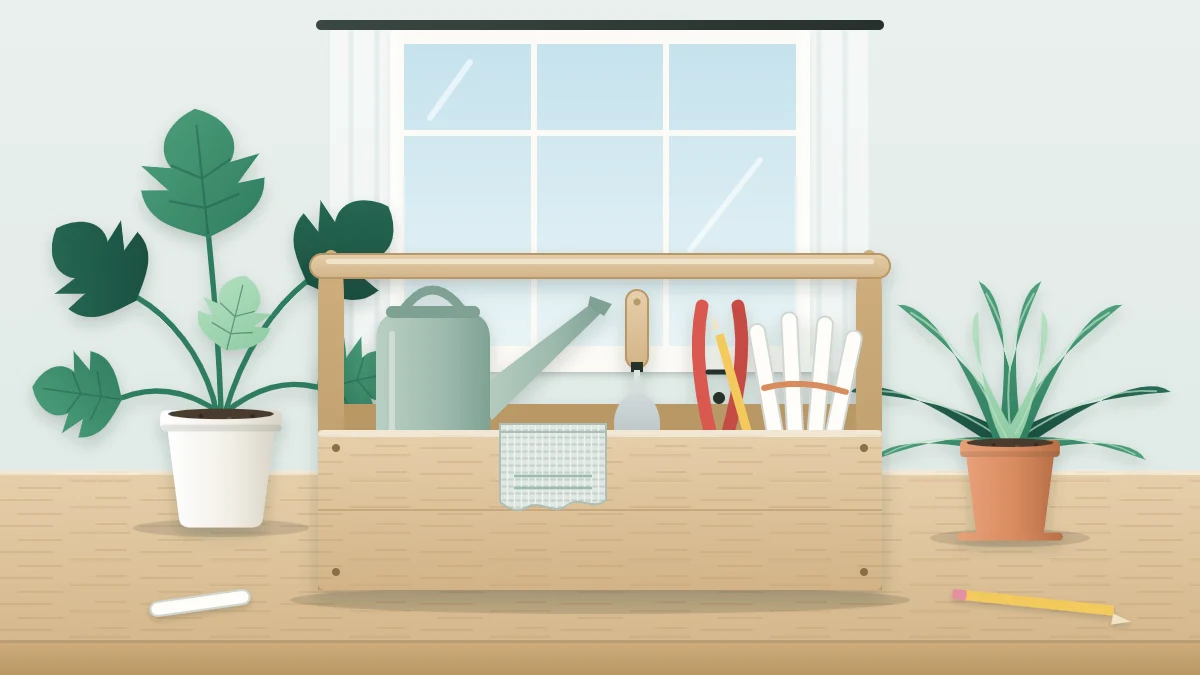
Put the watering can, snips, cloth, labels, pencil and notebook in one caddy, basket or lidded box, and keep it within a few steps of the growing area. When the kit is close, a walk-round takes minutes and actually happens. When it is spread over three rooms, it gets postponed.
A caddy with a handle is the most practical, because you can carry it from one group of plants to the next. This is the kit for routine indoor garden maintenance.
The messy kit, in a cupboard
Potting mix, spare pots, the potting tray and the trowel go in a second, closed bin in a cupboard or closet. A lidded bin keeps stray mix contained and stops the bag from tipping over.
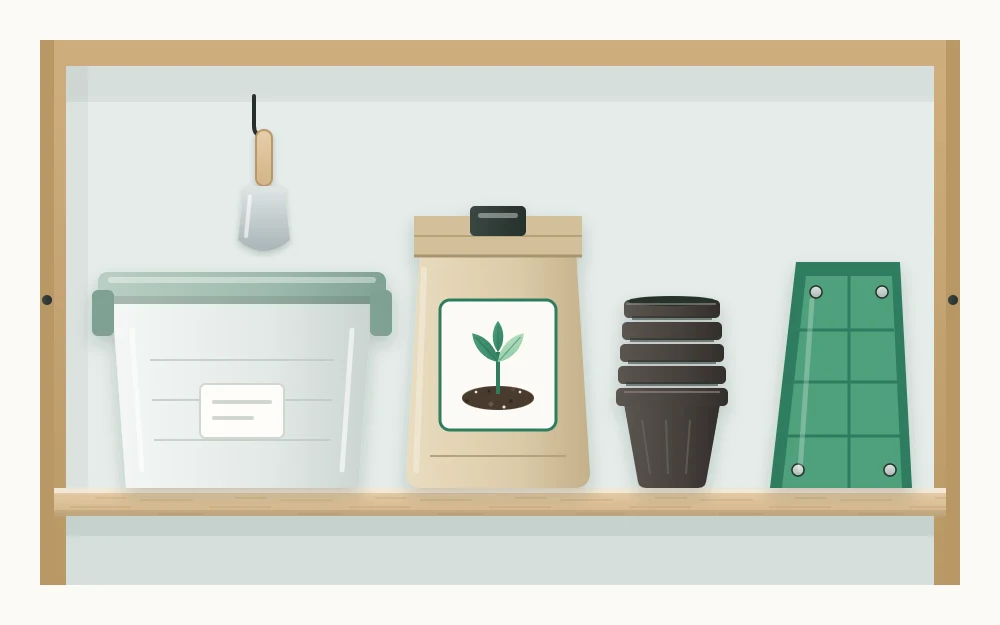
A few habits keep this bin pleasant to open:
- Fold the top of the mix bag over and clip it shut, so the mix neither dries to dust nor spills.
- Brush out pots before stacking them, and wash them before they are reused.
- Shake the tray or sheet out over the bin, then wipe it before folding it away. The guide to cleaning an indoor growing area covers washing pots and trays.
Fertilizers and plant-care products
Keep fertilizers and any other plant-care products in their original labeled containers, closed, and out of reach of children and pets. The label is where the directions are, so a product decanted into an unmarked bottle has lost the most useful thing about it.
Keep a simple plant log
The cheapest item in the kit may be the most useful. A small notebook, kept in the caddy, with one page or a few lines per plant: its name, the date it arrived, the date it was last repotted and anything you noticed.
Pair the log with a label in each pot. Plant names are surprisingly easy to forget, and the name is what you need when you want to look up how a plant likes to be grown. A pencil-written label pushed into the mix at the pot’s edge solves that for good.
Tip
Before buying anything new, write down the job you could not do last time for lack of it. If nothing comes to mind, the kit is complete for now.
Buying in the right order
If you are starting from nothing, begin with saucers, a watering can and snips, because you need them the day a plant comes home. Add the cloth, scoop, tray, spare pots and mix before the first repotting. Everything in the nice-to-have table can wait until a specific problem asks for it: a deep pot you cannot judge by touch, a floor plant too heavy to turn, or a light you want to run consistently.
Frequently asked questions
What tools does a beginner need for indoor plants?
Very few. A watering can with a long narrow spout, saucers or trays under every pot, and a pair of snips cover the first weeks. Add a soft cloth, a scoop, a potting tray, spare nursery pots and a bag of suitable potting mix before your first repotting.
Is a moisture meter worth buying?
It can be a helpful rough aid for deep pots where a finger does not reach, but readings vary with the potting medium and the meter. Treat it as a second opinion and confirm by feeling the mix or lifting the pot. It is not an essential purchase.
How should I store an open bag of potting mix indoors?
Fold the top over, clip it shut and stand the bag inside a lidded bin in a cupboard or closet. That keeps the mix from spilling or drying to dust and stops the bag from tipping. Storing the trowel, spare pots and potting tray in the same bin keeps the mess in one place.