
The Ultimate Bedtime Yoga Guide for Happy Hips and Backs
Your Hips and Back Are Begging for This Before-Bed Habit
Bedtime yoga for hips and back is one of the simplest ways to ease tension, reduce pain, and fall asleep faster — no gym, no equipment, and no experience required.
Quick answer: Here’s what it involves:
- Lie on your back in bed or on a mat
- Move through gentle poses like Figure 4, Happy Baby, and Reclined Twist
- Hold each pose for 5–10 slow breaths
- Spend 10–15 minutes total — that’s all it takes
- Practice nightly for the best results over time
Think about how your body feels at the end of a long day. Your lower back is stiff. Your hips feel locked up. You lie down, but your body won’t fully relax.
That’s not just tiredness. That’s tension that built up hour by hour — from sitting, commuting, stress, and everything in between.
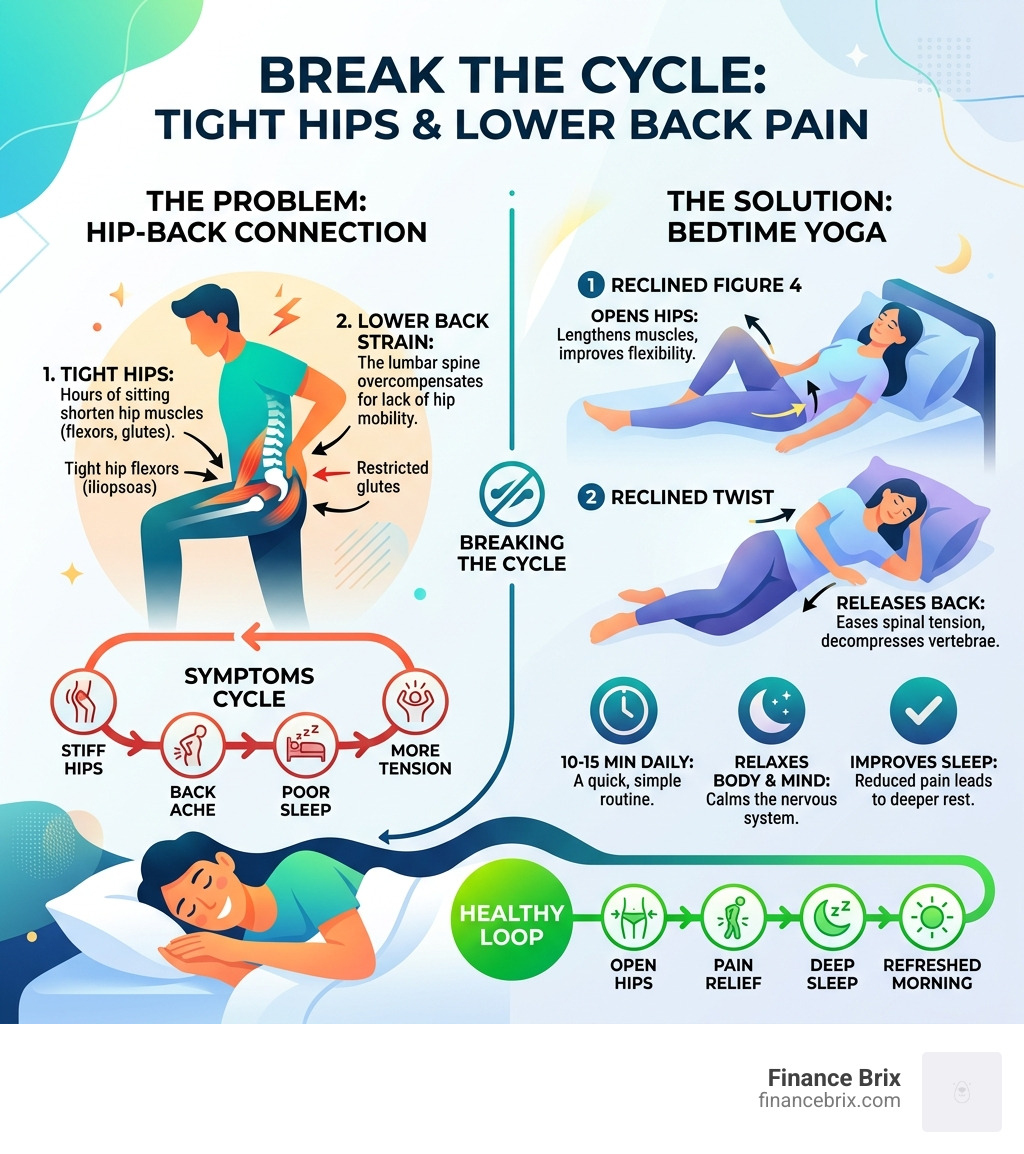
And here’s the thing most people miss: tight hips and lower back pain are connected. When your hips can’t move freely, your lower back overcompensates. That creates a cycle of stiffness, discomfort, and poor sleep.
Research backs this up — poor sleep makes pain feel worse, and pain makes sleep harder. It’s a loop that’s tough to break.
A short yoga routine before bed can interrupt that cycle. It loosens the hips, releases spinal tension, and signals to your nervous system that it’s time to wind down.
No complicated poses. No hour-long sessions. Just a few minutes of mindful movement that your body will thank you for.
Why Practice Bedtime Yoga for Hips and Back?
It is April 2026, and we are seeing a massive shift in how people approach evening wellness. We’ve moved away from high-intensity night workouts toward “downshifting”—the process of intentionally slowing the body’s systems to prepare for rest. Bedtime yoga for hips and back is the gold standard for this transition.
The Science of “Rest and Digest”
When we practice gentle yoga, we aren’t just stretching muscles; we are communicating with our nervous system. Deep, mindful movement activates the parasympathetic nervous system, often called the “rest and digest” mode. This counteracts the “fight or flight” response triggered by daily work stress or blue light exposure.
Scientific research consistently shows that yoga can ease nighttime joint pain, including discomfort linked to conditions like knee osteoarthritis. Furthermore, data from health programs indicates that participants who engage in regular therapeutic movement report a 44% improvement in sleep quality and an average 68% reduction in pain within just 12 weeks.
The Hip-Back Connection
Why focus on these two areas specifically? In our modern world, we spend a lot of time sitting. This causes our hip flexors to shorten and tighten. Because the hips are essential for walking, standing, and power transfer, when they become restricted, the body looks elsewhere for mobility. Usually, it steals that mobility from the lower back.
This “compensatory strain” is why your back often aches even if you haven’t lifted anything heavy. By releasing the hips before bed, you allow the lower back to settle into its natural alignment, preventing that “stuck” feeling when you try to find a comfortable sleeping position.
Emotional Storage: “Hips Keep the Score”
There is also a fascinating emotional component. Many yoga practitioners and wellness experts believe that we store unprocessed stress and emotions in our hips. When we “push through” a difficult day without processing our feelings, that tension manifests physically. Releasing the hips is as much a mental “unwinding” as it is a physical one. You can learn research on how sleep quality impacts pain perception to see how these mental and physical states are inextricably linked.
Essential Poses for Releasing Tension
You don’t need to be a “yogi” to do this. We focus on simple, effective shapes that prioritize comfort over “the perfect stretch.”
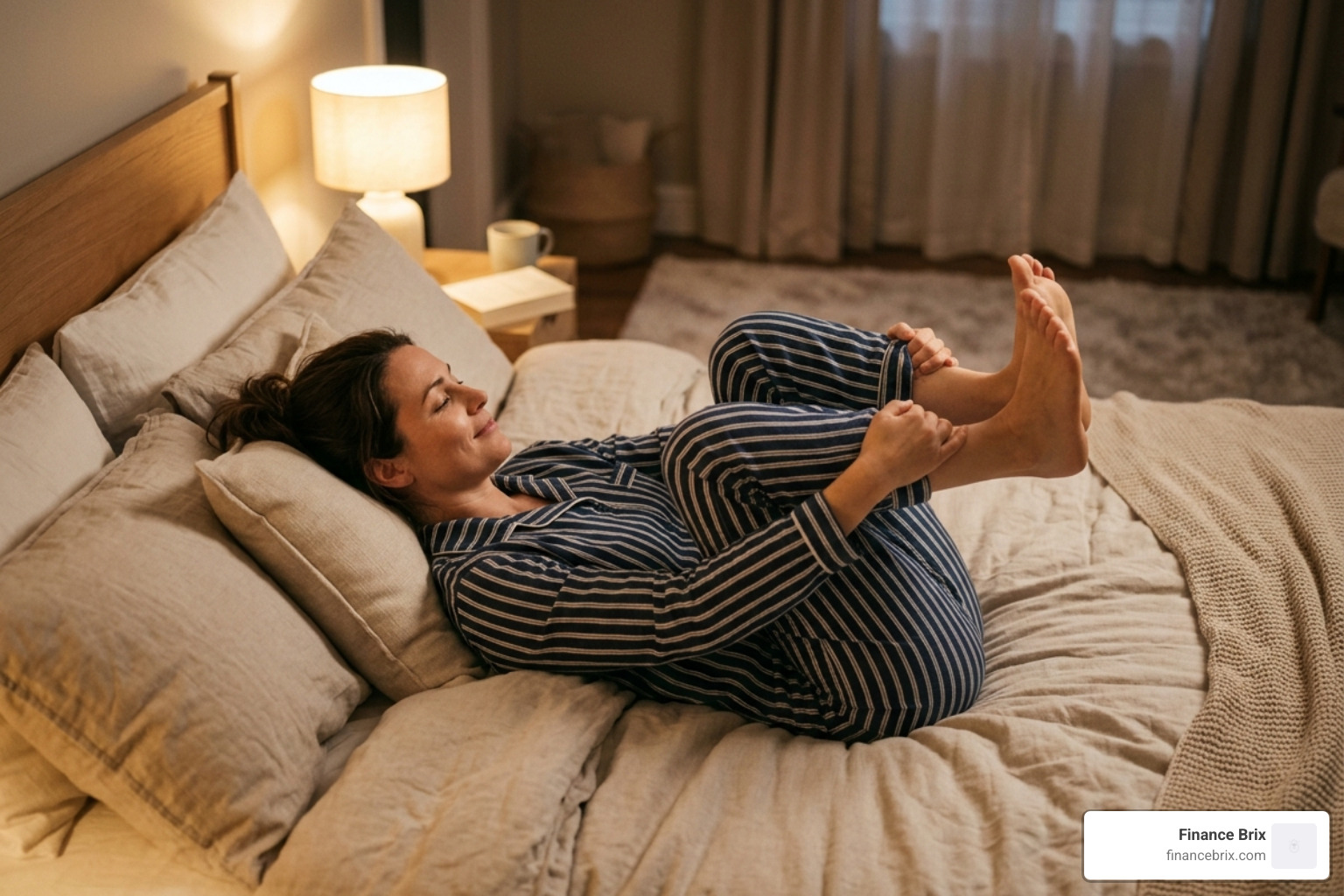
1. Figure 4 Stretch (Reclined Pigeon)
This is the ultimate “desk worker” pose.
- How to do it: Lie on your back with knees bent. Cross your right ankle over your left knee.
- The Action: Gently press your right knee away from your body. For a deeper stretch, lift your left foot off the bed and clasp your hands behind your left thigh.
- Why it works: It targets the piriformis and outer glutes, which are major contributors to lower back tightness.
2. Happy Baby Pose
- How to do it: Lie on your back and bring your knees toward your armpits.
- The Action: Reach up and grab the outside edges of your feet (or your ankles/shins if feet are too far). Keep your lower back pressed into the mattress.
- Why it works: It opens the inner groins and decompresses the spine. Feel free to rock gently side-to-side to massage the lower back.
3. Reclined Bound Angle
- How to do it: Lie flat and bring the soles of your feet together, letting your knees fall open to the sides.
- The Action: Place your hands on your belly or by your sides. If your hips feel too tight, place pillows under each knee for support.
- Why it works: This is a passive hip opener that allows gravity to do the work while you focus on breathing.
4. Cat-Cow (Modified for Bed)
If your mattress is firm enough, you can do this on all fours. If not, try it seated.
- The Action: Inhale as you arch your back and look up (Cow). Exhale as you round your spine and tuck your chin (Cat).
- Why it works: It creates space between the vertebrae and encourages “spinal flossing,” which releases the nerves that run from your back down to your legs.
5. Legs Up the Wall
- How to do it: Scoot your hips as close to the wall (or headboard) as possible and swing your legs up.
- Why it works: This is the “queen” of restorative poses. It encourages blood flow back to the heart and completely releases the psoas muscle, which is often the culprit behind deep lower back pain. You can find more info about fitness routines on our main site to see how this fits into a broader wellness plan.
Beginner-Friendly Bedtime Yoga for Hips and Back
If you are just starting, the most important rule is to stay within your edge. This means you should feel a gentle “pull,” but never sharp pain.
- Use Pillows: Don’t be afraid to stack pillows under your knees in a spinal twist or under your hips in Sphinx pose.
- Knee Rocking: If a pose feels too static, simply hug your knees to your chest and rock gently. This “micro-movement” is often more effective for relaxation than a deep, intense stretch.
- Modified Low Lunge: If you’re on the floor, a gentle lunge can help, but in bed, we recommend sticking to reclined (lying down) versions of these poses to keep the heart rate low.
Maximizing Bedtime Yoga for Hips and Back with Breathwork
The physical pose is only half the battle. To truly “unlock” the hips, you must use your breath.
- Nasal Breathing: Always breathe in and out through your nose. This filters the air and immediately signals the brain to calm down.
- The 5-5 Rule: Try to inhale for a count of 5 and exhale for a count of 5. This rhythmic breathing helps downregulate the nervous system.
- Diaphragmatic Breathing: As you lie in these poses, imagine your breath traveling all the way down into your hips. When you exhale, imagine the tension leaving your body like steam.
- Body Scanning: While holding a pose, mentally scan your jaw, shoulders, and forehead. Are you clenching? Soften those areas to allow the hips to release more deeply.
How to Create Your 15-Minute Routine
Consistency is more important than duration. Five minutes every night is better than sixty minutes once a week.
| Feature | 5-Minute “Quick Fix” | 15-Minute “Deep Dive” |
|---|---|---|
| Primary Goal | Release immediate stiffness | Full nervous system reset |
| Number of Poses | 2-3 (e.g., Figure 4, Twist) | 5-7 (Full sequence) |
| Hold Time | 1 minute per side | 2-3 minutes per side |
| Breath Focus | Basic deep breathing | 5-count nasal breathing |
| Best For | Late nights / exhaustion | Standard nightly routine |
Setting the Scene for Bedtime Yoga for Hips and Back
To get the most out of your bedtime yoga for hips and back, you need to signal to your brain that the day is over.
- Dim the Lights: Use a bedside lamp rather than overhead lights.
- Temperature: A slightly cool room (around 65-68°F or 18-20°C) is generally best for sleep.
- No Screens: Try to keep the phone away for at least 30 minutes before your yoga practice. If you are following a video, set it up, then put the phone face down.
- Comfortable Pajamas: Wear loose clothing that doesn’t restrict your waist or hips.
- Scent and Sound: A little lavender oil or some soft, wordless music can deepen the sensory experience of “unwinding.”
Frequently Asked Questions about Bedtime Yoga
Can I perform these yoga poses directly in bed?
Absolutely! In fact, we encourage it. Performing bedtime yoga for hips and back in bed makes it much more likely that you’ll actually do it.
- Surface Stability: If you have a very soft memory foam mattress, you might find balance poses tricky, but since most of these are reclined, the mattress actually provides excellent support for the spine.
- Alignment: Use your bed pillows to support your joints. For example, in a supine twist, placing a pillow between your knees keeps your hips stacked and prevents lower back strain.
How often should I practice for lasting relief?
For lasting relief, aim for daily practice. While you will feel better after just one session, the cumulative benefits are where the magic happens. Research shows that it takes about 12 weeks of consistent movement to see a significant, long-term reduction in chronic pain and a total shift in sleep patterns.
What props are recommended for a comfortable routine?
You don’t need fancy equipment, but a few household items can help:
- Bed Pillows: Use them for elevation and support.
- A Folded Blanket: Great for padding under the knees if you do Cat-Cow.
- A Towel: Roll it up and place it under your neck if you feel tension while lying flat.
- Eye Mask: To block out all light during your final resting pose (Savasana).
Conclusion
At Finance Brix, we believe that fitness shouldn’t be complicated or stressful. It should fit into your real life and make your days—and nights—better. Incorporating bedtime yoga for hips and back into your evening ritual is a small investment that pays massive dividends in how you feel the next morning.
By releasing the day’s physical and emotional tension, you aren’t just stretching; you’re giving your body permission to heal. Whether you have five minutes or fifteen, your hips and back will thank you for the relief. Start your journey to better sleep today by trying just one of these poses before you turn out the light tonight. Happy resting!
