
Beginner Home Workout Mistakes and How to Avoid Them
Why So Many Beginners at Home Quit in the First Month
Beginners at home make the same mistakes over and over — and most of them have nothing to do with effort.
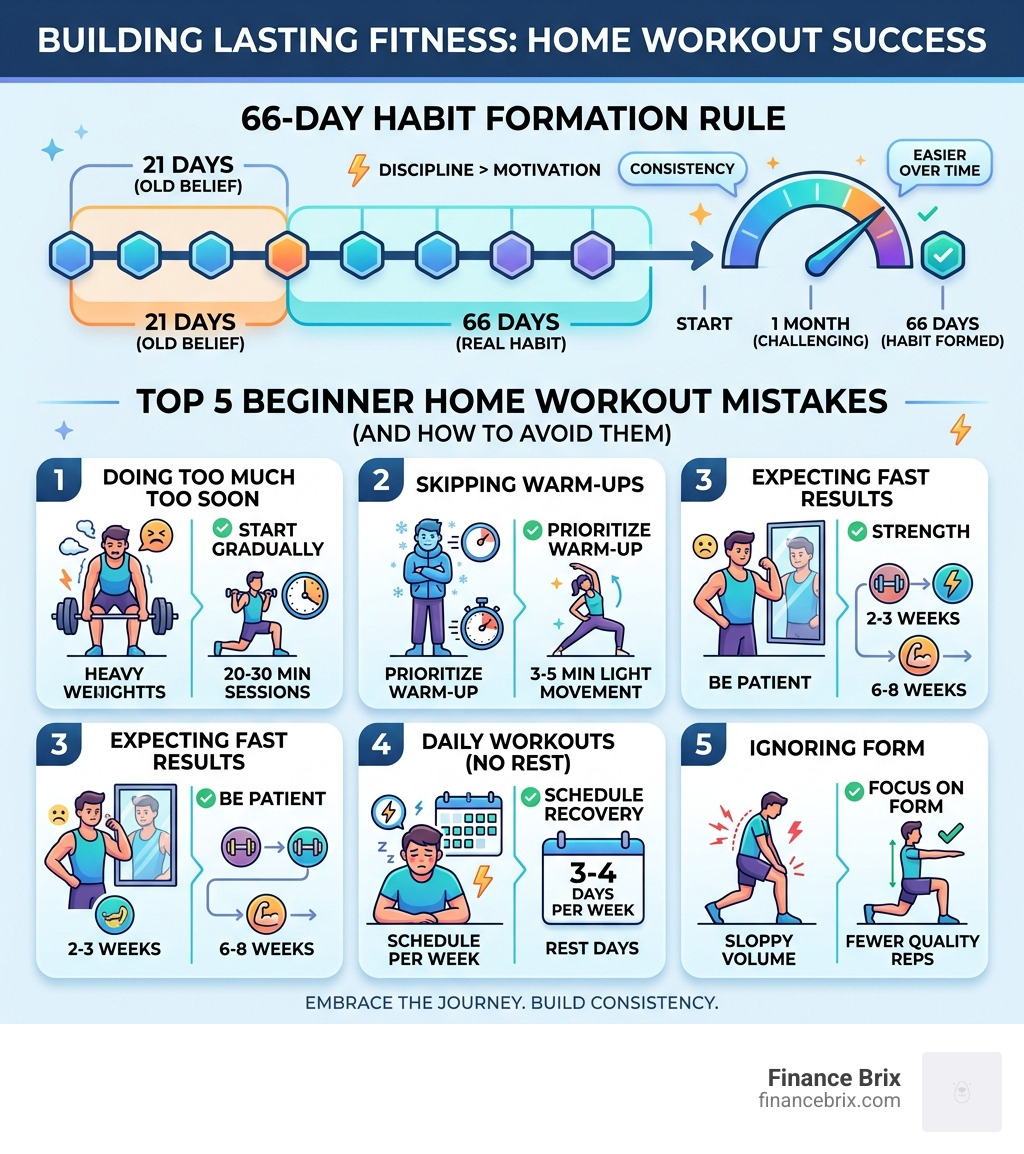
Here are the most common reasons home workouts fail, and what actually works instead:
| Mistake | Better Approach |
|---|---|
| Doing too much too soon | Start at 50-60% effort, 20-30 min sessions |
| Skipping warm-ups | Always do 3-5 min of light movement first |
| Expecting fast results | Strength shows in 2-3 weeks; tone in 6-8 weeks |
| Working out daily without rest | 3-4 days per week with recovery days |
| Ignoring form | Fewer reps with good form beats sloppy volume |
Starting a home workout routine feels simple. Sticking with it is where most people struggle.
Research shows it takes an average of 66 days to form a new habit — not the 21 days most people assume. That means the first month is the hardest part, and it’s exactly when most beginners give up.
The good news? The barriers to working out at home are lower than ever. You don’t need a gym membership, expensive equipment, or hours of free time. A 6×6 foot space and your own bodyweight are genuinely enough to build real strength and improve your fitness.
But small, avoidable mistakes — like skipping rest days, jumping into advanced moves, or training with poor form — are what derail most beginners before they ever see results.
This guide breaks down exactly what those mistakes are and how to sidestep them.
Why Beginners at Home Often Fail (and How to Succeed)
We often see people start their fitness journey with a burst of “Monday morning energy,” only to find their yoga mat gathering dust by Thursday. The primary reason beginners at home fail isn’t a lack of willpower; it’s a reliance on motivation rather than discipline. Motivation is a feeling that fluctuates, whereas discipline is a system that keeps you moving when you’d rather stay on the couch.
As of April 2026, we are seeing a massive shift in how people approach fitness. One of the standout trends is the “Japanese walking” method, which has seen search interest surge by nearly 3,000% year-over-year. This trend emphasizes low-impact, mindful movement that builds a foundation without causing burnout.
Scientific research on beginner exercise adherence suggests that those who choose home-based programs often have higher long-term compliance rates than those who join traditional gyms. Why? Because the “barrier to entry” is almost zero. You don’t have to drive anywhere or worry about who is watching you.
The physical rewards are significant, too. Many beginners at home can achieve “body recomposition”—the process of losing fat and gaining muscle simultaneously—within their first 8 to 12 weeks. Beyond the mirror, the mental health benefits are immediate, with mood and energy improvements often appearing in just 7 to 10 days. To stay on track, we recommend aiming for the Physical Activity Guidelines for Americans: at least 150 minutes of moderate-intensity exercise per week.
Essential Gear for Beginners at Home
One of the biggest myths we hear is that you need a garage full of heavy iron to get fit. In reality, bodyweight exercises are an incredibly effective way to build muscle mass, improve aerobic fitness, and manage body fat.
If you want to set yourself up for success, here is the basic kit we suggest:
- A 6×6 foot space: You just need enough room to lie down and extend your arms.
- A Yoga Mat: This provides grip and cushioning for your joints.
- Water Bottles or Soup Cans: These are perfect 1-3 pound dumbbell substitutes for upper-body moves like bicep curls or overhead presses.
- Resistance Bands: These are affordable, take up no space, and allow you to add “weight” to your movements without bulky equipment.
- A Sturdy Chair: Great for assisted squats or tricep dips.
Mastering Form in Beginners at Home Routines
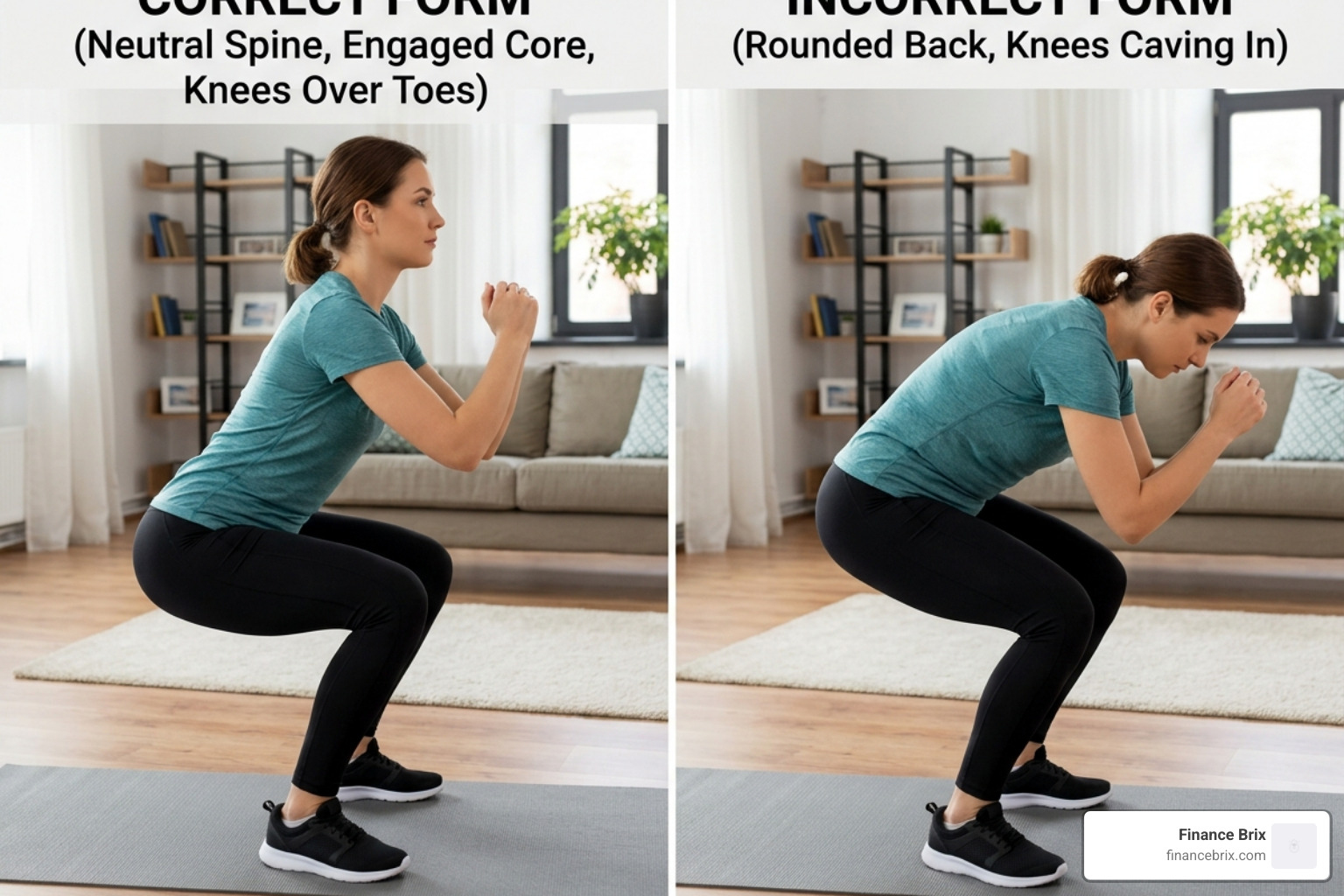
When you’re working out alone, you don’t have a coach to poke your shoulder and tell you your back is rounding. This makes form the most critical factor for beginners at home. Poor form doesn’t just make the exercise less effective; it invites injury.
We recommend focusing on these four pillars of form:
- Neutral Spine: Whether you are squatting or doing a plank, keep your head, neck, and back in a straight line.
- Core Engagement: Imagine someone is about to poke you in the stomach; that “bracing” feeling protects your lower back.
- Knee Alignment: In lunges and squats, ensure your knees track over your toes rather than caving inward.
- Proper Breathing: Never hold your breath. Generally, you should exhale during the “hard” part of the move (the exertion).
More info about fitness routines can help you understand how to align these movements into a cohesive plan. Using a mirror or recording yourself on your phone for “mirror feedback” is a great way to spot mistakes in real-time.
Common Equipment and Form Mistakes to Avoid
The most common mistake we see is “ego lifting”—even when using bodyweight. Beginners often try to do the most difficult version of an exercise (like a full push-up) before they have the strength to do it with a straight back. It is always better to do 5 modified push-ups on your knees with perfect form than 20 “worm” push-ups with a sagging middle.
Another major pitfall is skipping the warm-up. Cold muscles are like cold rubber bands; if you pull them too hard, they snap. A 3-5 minute dynamic warm-up increases blood flow and prepares your joints for the work ahead. Similarly, ignoring “bad” pain (sharp, stabbing, or localized in a joint) can lead to long-term injuries. While muscle soreness (DOMS) is normal, joint pain is a signal to stop immediately.
Avoiding the “Too Much Too Soon” Trap
Many beginners at home fall into the trap of trying to work out for 90 minutes every day. This almost always leads to overtraining and burnout. For a beginner, 50-60% intensity is the “sweet spot.” You should feel challenged, but you shouldn’t feel like you’re going to collapse.
More info about beginner workouts emphasizes the 48-hour recovery rule: avoid training the same muscle group two days in a row. Muscle isn’t actually built while you are sweating; it’s built while you are sleeping and resting. If you don’t give your fibers time to repair, you won’t see the progress you’re working so hard for.
Structuring Your Routine: The 20-30 Minute Blueprint
A successful workout for beginners at home follows a specific flow. You want to move from “general” to “specific” and then back to “relaxed.”
| Phase | Duration | Activities |
|---|---|---|
| Dynamic Warm-Up | 3-5 Mins | Marching in place, arm circles, hip rotations, slow squats |
| Main Circuit | 15-20 Mins | Strength moves performed back-to-back with minimal rest |
| Cool-Down | 3-5 Mins | Static stretching (holding poses), deep breathing |
This circuit-style training is efficient because it keeps your heart rate elevated (cardio) while you build muscle (strength).
Sample Circuit for Beginners at Home
Perform each of these moves for 30-45 seconds, rest for 15 seconds, and repeat the whole loop 2-3 times.
- Bodyweight Squats: Focus on sitting back into an imaginary chair, keeping your chest up.
- Modified Push-Ups: Keep your knees on the ground and your elbows at a 45-degree angle to your body.
- Reverse Lunges: Step back and lower your back knee toward the floor, keeping your front shin vertical.
- Forearm Planks: Hold a straight line from your head to your heels (or knees).
- Glute Bridges: Lie on your back and lift your hips toward the ceiling, squeezing your glutes at the top.
- Bird-Dog: On all fours, extend the opposite arm and leg simultaneously to build core stability.
More info about home exercises can provide further variations if these feel too easy or too difficult.
Progression and Recovery: Moving Beyond the Basics
Once you’ve mastered the basics, you need “progressive overload” to keep seeing results. This doesn’t necessarily mean buying heavier weights. For beginners at home, you can progress by:
- Increasing Repetitions: Doing 15 squats instead of 10.
- Time Under Tension: Slowing down the movement (e.g., taking 3 seconds to lower into a squat).
- Reducing Rest: Taking 10 seconds of rest instead of 30.
- Harder Variations: Moving from knee push-ups to full push-ups.
Recovery is just as active as the workout itself. Scientific research on muscle repair shows that hydration and sleep quality are the two biggest factors in how quickly you bounce back. We also recommend light movement on rest days—like a 20-minute walk or some foam rolling—to help flush out metabolic waste and reduce soreness.
Frequently Asked Questions about Home Fitness
How often should a beginner work out at home?
We recommend 3-5 days per week. Starting with 3 days (e.g., Monday, Wednesday, Friday) is often best for beginners at home because it guarantees a rest day between every session. Consistency over intensity is the golden rule. It is much better to do three 20-minute workouts every week for a year than to do five 60-minute workouts for two weeks and then quit.
Can you build muscle with just bodyweight exercises?
Absolutely. By using progressive overload and focusing on “time under tension,” you can trigger muscle growth effectively. Bodyweight training improves muscular endurance, balance, and core stability simultaneously. While you might not become a professional bodybuilder without heavy weights, you can certainly develop a lean, toned, and strong physique.
Is a 20-minute home workout actually effective?
Yes! A 20-minute session can provide a significant metabolic boost and improve your cardiovascular health. While the Physical Activity Guidelines suggest 150 minutes a week, those minutes don’t have to happen all at once. Even 10-minute “exercise snacks” throughout the day have been shown to improve energy levels and health markers. More info about fitness benefits explains how these short bursts contribute to long-term longevity.
Conclusion
At Finance Brix, we believe fitness shouldn’t be complicated or intimidating. You don’t need a fancy gym to transform your health; you just need a plan and the discipline to stick with it. By avoiding the common “too much, too soon” trap and focusing on proper form, beginners at home can achieve results that last a lifetime.
Whether you are starting with a 15-minute yoga flow or a 20-minute bodyweight circuit, the most important step is the one you take today. Focus on the process, celebrate the small wins, and remember that every workout is an investment in your future self.
