
Yoga Sequence to Revolved Triangle: Tips for Tight Spots
Understanding Revolved Triangle Pose (Parivrtta Trikonasana)
To master the Revolved triangle pose, we first need to understand its roots and its unique mechanics. The name comes from three Sanskrit words: Parivrtta (revolved), Trikona (three-angle or triangle), and Asana (pose). While it shares a name with the classic Extended Triangle, it is a completely different beast.
In our experience at Finance Brix, we’ve found that many practitioners treat this as a simple stretch. In reality, it is a sophisticated “closed-chain” twist. This means your feet are grounded and your hands are often connected to a surface, creating a circuit of tension and stability. Unlike many other twists that happen in the lower back (where the spine isn’t actually designed to rotate much), this pose targets the thoracic rotation—the middle and upper back.
Because it requires you to balance while twisted and folded forward, it demands high levels of core stability and proprioception (your body’s ability to sense its location in space). It is widely considered an intermediate pose, but with the right approach, it serves as a “stepping stone” to deeper body awareness. For a deeper dive into how this pose balances your body’s alignment, check out this guide on Revolved Triangle Pose – Balance, Detox & Alignment.
Step-by-Step Guide to Mastering the Technique
Mastering the Revolved triangle pose is all about the setup. If your feet are in the wrong place, the twist will feel impossible. Let’s walk through the process of building this pose from the ground up.
- Start in Tadasana (Mountain Pose): Stand at the top of your mat with your feet hip-width apart. This gives us a solid foundation.
- Step Back: Step your left foot back about 3 to 4 feet. Unlike Warrior II, where the feet are on one “tightrope,” keep your feet about hip-width apart (like they are on train tracks). This makes squaring your hips much easier.
- Align the Feet: Turn your back (left) foot out to about a 45-degree angle. Your front (right) foot should point straight ahead. Ensure your heels are aligned or slightly offset for better balance.
- Square the Hips: This is the most important step. Place your hands on your hips and physically guide your right hip back and your left hip forward until they are level and facing the front of the mat.
- Lengthen the Spine: Inhale and reach both arms out to the sides at shoulder height. Imagine your spine growing taller from the tailbone to the crown of your head.
- Hinge and Rotate: Exhale and hinge forward from your hips over your front leg. Keep your spine long—don’t round your back yet! Once your torso is parallel to the floor, rotate your chest to the right.
- Hand Placement: Place your left hand down. For beginners, place it on your right shin or a block. For the full expression, place it on the floor on the outside of your right foot.
- Reach and Gaze: Extend your right arm toward the ceiling, stacking your shoulders vertically. If your neck feels okay, turn your gaze up toward your right thumb.
- Hold and Breathe: Stay for 3 to 5 deep breaths (about 30–60 seconds). With every inhale, lengthen your spine; with every exhale, deepen the twist.
- Exit Safely: To come out, look down at the floor, exhale, and use the strength of your legs to lift your torso back up. Return to Mountain Pose and repeat on the other side.
Comparing the Triangles
It helps to see how this differs from the standard Triangle Pose to avoid confusing the two:
| Feature | Extended Triangle (Utthita) | Revolved Triangle (Parivrtta) |
|---|---|---|
| Hip Position | Open to the side | Squared to the front |
| Spine Action | Lateral (side) stretch | Axial rotation (twist) |
| Primary Stretch | Inner thighs/groin | IT band/Outer hip |
| Difficulty | Beginner/Intermediate | Intermediate |
Alignment Cues for a Safe Revolved Triangle Pose
To keep your body safe and get the most out of the Revolved triangle pose, keep these cues in mind:
- Hug the Midline: Imagine squeezing a beach ball between your inner thighs. This “hugging” action stabilizes the pelvis.
- Ground the Back Heel: It’s tempting to let the back heel lift. Work diligently to press the outer edge of that back foot into the mat. This is your anchor.
- Lengthen Before Rotating: Never twist a “crunchy” or rounded spine. Always reach the crown of your head forward to create space between your vertebrae before you start the rotation.
- Shoulder Stacking: Try to keep your arms in one long, vertical line. If your top shoulder is collapsing forward, you’ve gone too far—back off and focus on the chest opening.
For more technical alignment tips, visit Yoga Pose | Revolved Triangle | ONEYOGAHOUSE.
Using Props in Revolved Triangle Pose
We are big fans of props here at Finance Brix. Using a block doesn’t mean you aren’t “good” at yoga; it means you are smart enough to prioritize alignment over touching the floor.
- Yoga Blocks: Place a block on the inside (easier) or outside (harder) of your front foot. This brings the floor to you, allowing you to keep your spine straight rather than rounding your back to reach the ground.
- The Wall: Practice with your back heel pressed against a wall. This provides a sense of security and helps you keep that back leg active. You can also practice facing the wall, using your hands on the wall to help “climb” into the twist.
- A Chair: For those with very tight hamstrings or balance issues, place your bottom hand on the seat of a sturdy chair. This makes the pose much more accessible while still providing the detoxifying twist.
Benefits and Anatomy of the Twist
Why put ourselves through this “pretzel” shape? The benefits are extensive, affecting both the physical and energetic bodies.
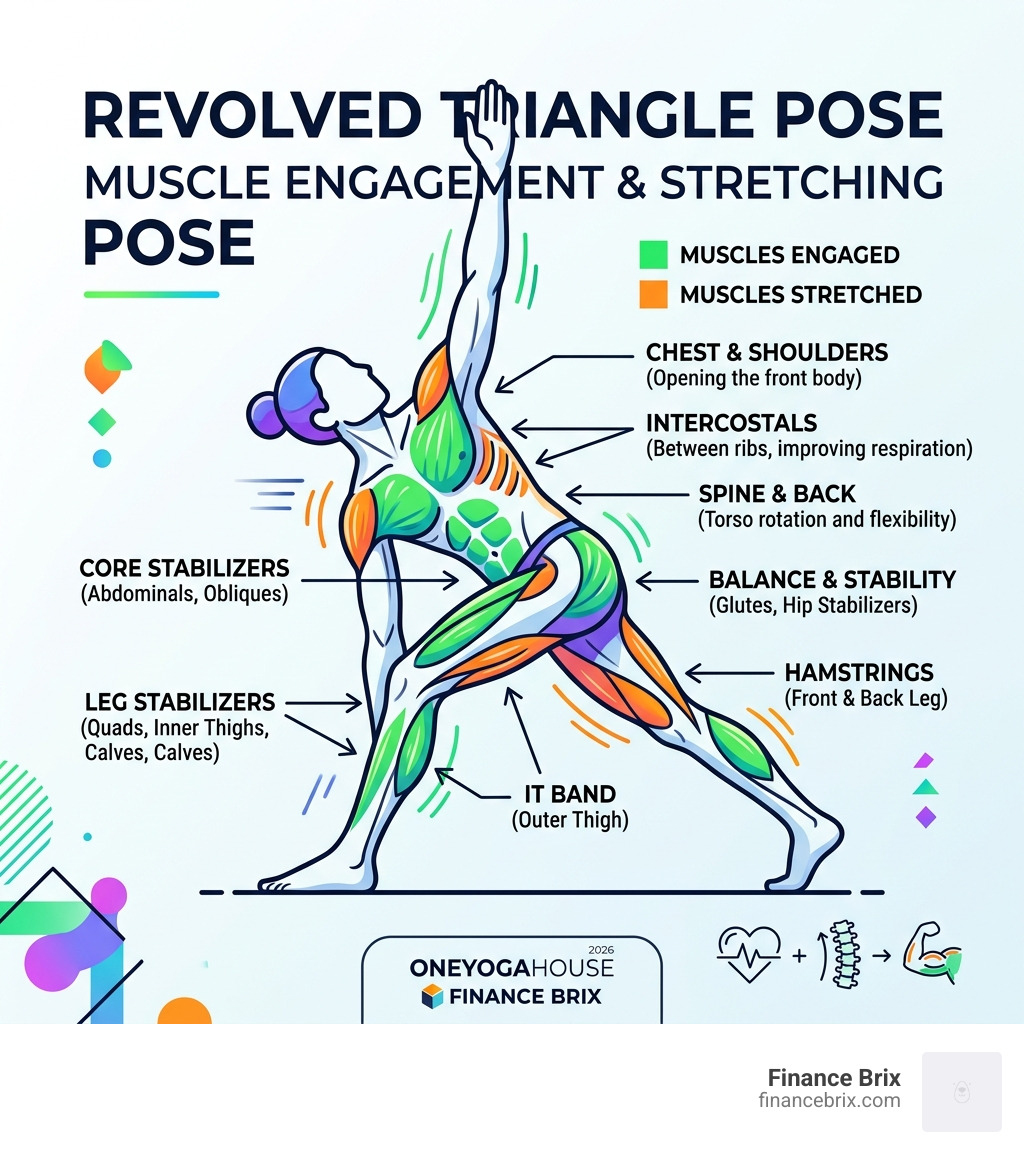
1. The IT Band and Hamstring Release If you are a runner or cyclist, your IT band (the thick band of tissue running down the outside of your thigh) is likely tight. Revolved triangle pose is one of the few standing poses that effectively targets this area, along with the hamstrings and calves.
2. Stimulating “Jatharagni” (Metabolic Fire) In yoga philosophy, twists are thought to stimulate the internal organs. By compressing the abdominal cavity, we massage the liver, kidneys, and intestines. This is often called a “squeeze and soak” action—we squeeze the blood out of the organs, and when we release the pose, a fresh supply of oxygenated blood rushes back in. This aids in digestion and detoxification.
3. Thoracic Mobility In our modern world, we spend a lot of time hunched over desks. This causes the thoracic spine (mid-back) to become stiff. This pose forces that area to move, improving your posture and even expanding your respiratory capacity by stretching the intercostal muscles between your ribs.
Sequencing: Preparatory and Counter Poses
You wouldn’t try to run a marathon without a warm-up, and you shouldn’t jump into Revolved triangle pose without prepping your “tight spots.”
Preparatory Poses
We recommend including these in your sequence before attempting the full twist:
- Downward Facing Dog: To warm up the hamstrings and lengthen the spine.
- Warrior I: To practice squaring the hips and grounding the back heel.
- Pyramid Pose (Parsvottanasana): This is essentially the “halfway” point. It mimics the leg position and the forward fold without the twist.

Counter Poses
After you’ve finished both sides, help your body neutralize with these:
- Standing Forward Fold (Uttanasana): To let the spine hang heavy and release any tension in the back.
- Child’s Pose (Balasana): A gentle way to relax the hips and lower back.
- Cow Face Pose (Gomukhasana): Great for further releasing the outer hips and shoulders.
Common Mistakes and Contraindications
Even experienced yogis can fall into bad habits with the Revolved triangle pose. Watch out for these:
- Rounding the Spine: If you can’t reach the floor without your back looking like a camel’s hump, use a block! A rounded spine cannot twist safely.
- Dumping into the Shoulder: Don’t put all your weight into the bottom hand. Use your core to “lift” out of the pose.
- Over-twisting the Neck: Many people think they are twisting deeply because they’ve turned their head. The twist should come from the mid-back, not the neck. If your neck hurts, look down at your foot.
- SI Joint Torsion: If you feel sharp pain in your lower back or sacrum, stop. This usually happens when the hips aren’t squared properly, causing the pelvis to twist in a way that stresses the sacroiliac joint.
Who should avoid this pose? Avoid or significantly modify this pose if you have:
- Recent spinal, hip, or abdominal surgery.
- Herniated discs in the back.
- Pregnancy (deep closed twists are generally avoided).
- High blood pressure or migraines (due to the head position).
- Severe vertigo or balance issues.
Frequently Asked Questions about Revolved Triangle
Is Revolved Triangle Pose suitable for beginners?
It is a challenging pose, but beginners can certainly approach it! We suggest starting with a “shortened stance” (bring your feet closer together) and always using a block under the bottom hand. Focus on the leg strength and hip squaring first before adding the full arm extension.
How does this pose aid in digestion and detox?
The twisting motion creates intra-abdominal pressure. Think of it like wringing out a wet towel. This “massages” the digestive tract, which can help with bloating and sluggish digestion. It’s a great pose to practice in the morning to “wake up” your internal systems.
Should my hips stay perfectly square during the twist?
In an ideal world, yes. Imagine your sacrum (the flat bone at the base of your spine) is level enough that you could set a cup of tea on it without it spilling. However, for most people, the hip on the side you are twisting toward will want to “hike up.” Work on drawing that outer hip back and down to keep the pelvis stable.
Conclusion
At Finance Brix, we believe that fitness should be straightforward and accessible. The Revolved triangle pose might seem intimidating at first, but it is truly a “master key” for unlocking the body. It teaches us about the relationship between our feet and our spine, and between our breath and our balance.
By focusing on stability before flexibility and using props whenever necessary, you can turn this challenging twist into a rewarding part of your routine. Yoga is a practice, not a performance. Be patient with your tight spots, breathe through the wobbles, and enjoy the process of finding your center.
For more straightforward fitness guidance and routines, visit us at Finance Brix.
